PR6's Flexibility Mechanism: What the €13.8 Billion Grid Investment Actually Means for Demand Flexibility
- Triple Edge Energy
- Energy Markets , Flexibility Services
- 28 Mar, 2026
On 16 December 2025, the Commission for Regulation of Utilities published the PR6 Final Determination — the regulatory price review that sets the allowed revenues and investment programme for ESB Networks through the end of the decade. The headline figures are significant by any standard: a baseline investment envelope of €13.8 billion, rising to €18.9 billion under the high scenario. That is roughly 80% above the PR5 outturn of €7.6 billion.
The response was predictable and warranted. Minister O’Brien described it as “the most significant grid investment since rural electrification.” Frontier Economics characterised it as “an evolution in regulatory philosophy.” ECA called the scale “unprecedented.” That framing is not wrong. It is a genuine step-change in the ambition and funding of Ireland’s electricity infrastructure.
One point that deserves emphasis upfront: PR6 is not an announcement. It is a five-year regulatory cycle running from 1 January 2026 to 31 December 2030. The investment case, the incentive structures, and the commercial opportunities it creates are live now and will remain live through the end of the decade. The decisions businesses and aggregators make in the next two to three years will determine whether they are positioned to capture value from what the framework creates.
One element within that framework — the Flexibility Mechanism embedded in the DMSO allowances — has received less focused analysis than it deserves. That is the subject of this post.
What the Flexibility Mechanism Actually Is
The €13.8 billion baseline includes €1.8 billion allocated to distribution network reinforcement — the physical capex programme for upgrading cables, substations, and the copper-and-concrete infrastructure that keeps power flowing as demand grows.
The Flexibility Mechanism creates a formal, bi-directional reallocation pathway between that reinforcement capex envelope and DMSO flexibility opex. The logic is direct: if ESB Networks can resolve a network constraint by procuring demand-side flexibility rather than building a physical asset, funds redirect from the reinforcement budget to pay for that flex service. The mechanism works in reverse too — if flexibility cannot be sourced at sufficient scale or reliability, investment flows back to physical reinforcement.
This is a substitution mechanism embedded within the investment plan itself. It is not a separate flexibility fund sitting alongside the capex programme. The competitive frame of reference for DMSO flexibility procurement is the €1.8 billion reinforcement envelope — not a standalone opex allocation whose scale is determined independently of infrastructure need.
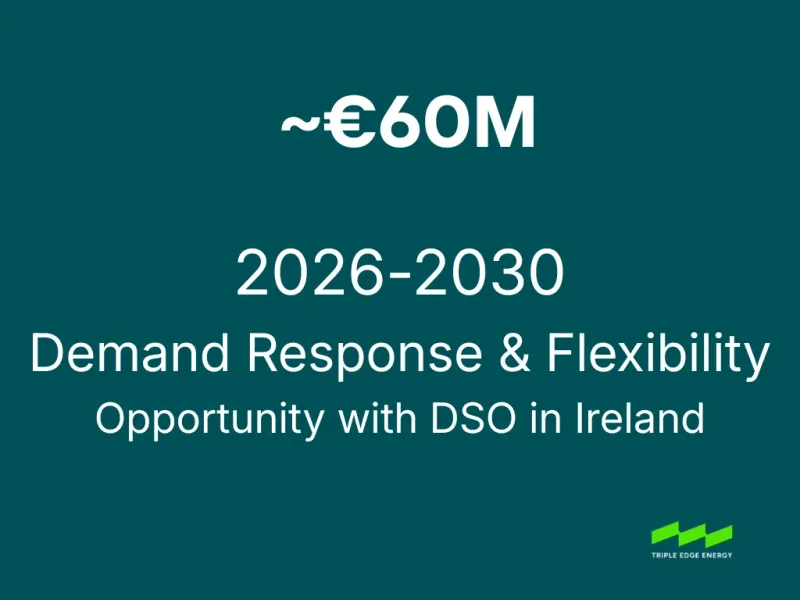
On the allowance figures: the Draft Determination (CRU202587, Table 22, pp. 65–66, published July 2025) included a DMSO flexibility allowance of €59.1 million. ESB Networks’ submission had requested €71.6 million. For context, the PR5 outturn was €9.6 million, with no ex-ante allowance — the €59.1 million draft figure represents approximately a six-fold increase on that outturn. The Final Determination (December 2025) has not published a category-level breakdown of DSO opex, so the specific flex component in the final approved figures is not confirmed from publicly available data. Overall DSO opex increased from draft to final, which suggests the flex component held or increased — but that is an inference, not a confirmed figure. The structural point remains: the mechanism design, the bi-directional reallocation logic, and the €1.8 billion frame of reference are all confirmed in the Final Determination.
Why This Matters Commercially
Most commentary on DMSO flexibility treats it as an opex category — a budget line that funds flexibility procurement as a complement to network investment. The Flexibility Mechanism makes that framing incomplete.
Demand-side flexibility, under PR6, competes against physical reinforcement for a share of the larger capex envelope. That changes two things.
First, the scale of the addressable market is larger. The value of a flexibility service is bounded by the cost of the physical alternative it displaces — the cable that does not need to be installed, the substation upgrade that can be deferred. That counterfactual is substantially larger than any standalone flex procurement budget would be.
Second, the investment case for demand-side participants is structurally stronger. A grid service payment anchored to a quantifiable counterfactual — avoided reinforcement cost — is more durable than a rate set by policy. It has an economic logic that does not depend on regulatory goodwill being maintained from one cycle to the next.
The wider context reinforces the urgency. Ireland has a national target of 20–30% flexible demand by 2030. EirGrid’s demand forecasts project a 45% increase by 2034. System peak already reached 6,024 MW in January 2025. The grid needs flexibility to be commercially viable, not merely technically available. PR6 creates the regulatory economics to support that.
What Has and Hasn’t Been Said
The PR6 Final Determination generated a reasonable volume of high-quality commentary. William Fry covered the WACC determination, the Asset Investment Management Framework, and the incentive and penalty structures in detail. Frontier Economics provided analysis of the shift in regulatory philosophy. ECA focused on investment scale and delivery risk — rightly, given the supply chain and resourcing challenges involved. KPMG addressed labour market and programme management constraints. Solar Ireland made the important point that there is no cost-free path through this transition. The consumer impact figure of €12–21 per household per year circulated widely.
That is the right macro conversation to have, and the analysis produced was substantive.
What received less attention than the topic deserves is the Flexibility Mechanism specifically — the structural design that positions demand-side flexibility as a substitute for network investment, not just a complement to it. The DMSO flexibility workings sit deep in hundreds of pages of technical material, and the macro questions about delivery risk and consumer cost were legitimate priority topics. But for businesses and aggregators active in the demand flexibility space, the substitution mechanism is the most commercially consequential design feature in the determination.
Triple Edge Energy works with businesses to identify, structure, and activate demand flexibility. We have a direct interest in understanding how the regulatory economics of that work are changing. PR6 changes them materially.
What Needs to Happen for the Mechanism to Work
Structural design is necessary but not sufficient. For the bi-directional reallocation mechanism to function as intended, several things need to come together between now and 2030. These are points we have raised directly — including at the IEA/ISGAN smart grids workshop in Dublin — and they remain the binding constraints.
Contract duration that justifies investment. Businesses will not invest capital in flexible assets — battery storage, controllable HVAC, flexible EV charging infrastructure — without contract durations long enough to underwrite the payback. The DFP’s 15-year contract structure is a positive signal, but it is one product in a broader pipeline. The DMSO Blueprint sets out multiple explicit flexibility routes to market — congestion management products, day-ahead and intraday flexibility, the XLEU scaled product, summer flex procurement, Demand Up — each at different stages of development. These products also need commercial runway: multi-year visibility on procurement cycles, contract terms, and revenue structures that give participants confidence to commit capital ahead of each procurement window. We wrote about the DMSO roadmap and what it means for businesses in an earlier post. The runway principle applies across the full product suite, not just the DFP.
Product maturity. ESB Networks’ DMSO product suite needs to reach a level of liquidity and settlement certainty that makes flexibility a plannable procurement option, not just a pilot. The DMSO Blueprint and Roadmaps published in 2025 set out the direction of travel — congestion management products, intraday options, operational coordination — but the timeline from roadmap to reliable market is not guaranteed, and the gap between publication and functioning market is where investment decisions are lost.
Clear requirements, published early enough. Participation criteria for each product need to be defined and published with sufficient lead time for businesses and their advisors to assess eligibility, make investment decisions, and prepare before procurement windows open. Flexibility is not a commodity that can be switched on at short notice. It requires site assessment, asset specification, operational planning, and often capital expenditure. If requirements emerge weeks before a procurement deadline, only incumbents who are already configured will participate. The market needs months, not weeks.
Better information on the value of flexibility. Businesses and energy consultants need concrete, published data on what flexibility is worth — not just the existence of products, but the economics of participation. What does a megawatt of curtailable load earn under the DFP? What does avoided reinforcement cost the grid at specific network locations? What are the revenue ranges for different asset types and participation profiles? This information exists within the regulatory framework but has not been translated into the kind of accessible, commercial language that drives investment decisions. The gap between regulatory documentation and business-case inputs is real and is slowing participation.
DFP first-batch data. The Demand Flexibility Product launched its first commercial batches under the PR5 framework. The settlement data, participation rates, and operational performance from those initial batches will be critical inputs to proving — or disproving — that demand flexibility can substitute for reinforcement at the scale the mechanism assumes. We are watching those results closely. Aggregation was not allowed participate in this first round - another item we are watching closely for next rounds.
Reinforcement cost transparency. For the substitution mechanism to work efficiently, market participants need visibility on where in the network reinforcement is expensive and planned. A clearer published methodology for how ESB Networks values flex against avoided capex — flagged in TEE’s feedback on the DMSO Blueprint consultation — would accelerate investment decisions and reduce information asymmetry between the network operator and the market.
PR6 runs until 31 December 2030. There is time to get this right, but the productive window for establishing the commercial patterns — the early procurement cycles, the initial bankable contracts, the first genuine capex deferrals — is the next two to three years. Entities that participate credibly in that early market will be better positioned to capture value as the mechanism matures.
Want to understand what PR6’s flexibility framework means for your business? Get in touch
References
- CRU (2025) PR6 Draft Determination — Distribution Paper (CRU202587). Commission for Regulation of Utilities, Dublin, July 2025. Table 22, pp. 65–66.
- CRU (2025) PR6 Final Determination (news release, 16 December 2025). Available at: cru.ie
- ECA (2026) Price Review 6: An Unprecedented Investment in the Irish Electricity Network. February 2026. Available at: eca-uk.com
- EirGrid (2024) Tomorrow’s Energy Scenarios: Ireland’s Demand and Generation Portfolios 2024–2040. EirGrid Group, Dublin.
- ESB Networks (2025) DMSO Blueprint and Roadmaps (DOC-280425-IFC). ESB Networks, Dublin.
- Frontier Economics (2025) Ireland’s PR6: An Evolution in Regulatory Philosophy? Available at: frontier-economics.com
- KPMG (2026) Energy Outlook 2026. KPMG Ireland. Available at: kpmg.com
- Solar Ireland (2025) PR6: A Decisive Investment in Ireland’s Energy Infrastructure. Available at: solarireland.ie
- William Fry (2025) CRU Approves Historic Investment Allowance of up to €18.9 Billion. Available at: williamfry.com