Ireland's Flexibility Market Is Taking Shape - What It Means for Business
- Triple Edge Energy
- Energy Markets , Flexibility Services
- 08 Sep, 2024
Over the Summer, ESB Networks published its DMSO Blueprint and Roadmaps, a long-term plan for how Ireland’s distribution system will evolve to 2035. If you missed it over the Summer, it’s worth a look. DMSO = Distribution Markets System Operator for the electricity grid.
The standout theme for us: a discrete flexibility market developing alongside the traditional retail market - backed by clear roadmaps and operational upgrades.
What’s New
Three coordinated tracks are due to move in step: Smart+ Retail Market, Flexibility Market, and Operations Transformation. Together, they set out priorities like enabling multi-supplier contracts and energy sharing on the retail side, while building dedicated flexibility products and IT/OT capabilities to manage and dispatch them.
Why This Matters for Irish Businesses
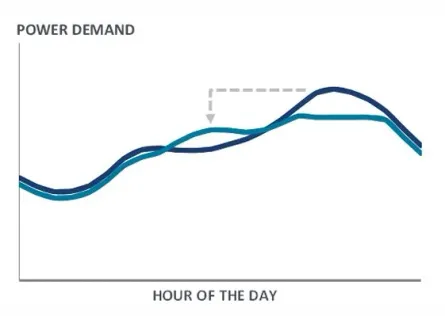
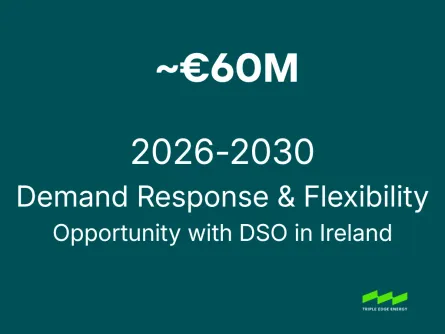
Demand is rising (electrification, industry – see our previous posts on this), while Ireland targets 80% renewable electricity by 2030 - a great goal that also increases variability on the system. Flexibility aligns demand usage with when power supply is cheapest and cleanest, and it can defer network reinforcement - turning operational alignment into new revenue for participants.
How All This Unlocks More Flexibility
- Customer awareness & simple routes to market like National Outreach programmes and Knowledge Hubs.
- New flexibility products for congestion management (day-ahead and intraday options as liquidity builds).
- Behind-the-meter (BTM) readiness & standards to make participation safer and simpler across devices.
- Flexible demand connections where capacity is tight, plus options like “demand-up” when renewables would otherwise be curtailed.
- Operational upgrades (LV/MV monitoring, SCADA, cyber resilience) so markets and operations reinforce each other.
Our Perspective and Feedback We Provided on This Roadmap Development
1) Make Participation Obvious for Customers
We welcome the strong emphasis on awareness and education. The eco-system visuals in the paper are a good start; the next step is actionable tools - e.g., an appliance/asset “flexibility calculator”, sector-specific examples, and plain-English onboarding checklists that demystify data permissions and metering. That lines up with the Blueprint’s Knowledge Hub/Outreach direction.
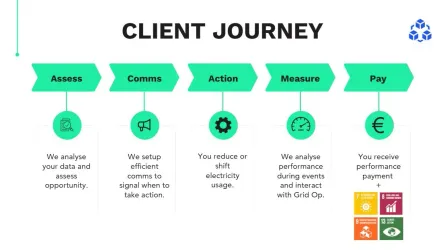
What we are doing for Clients: translating the new market opportunities into operational playbooks and simple dashboards: When to flex, how much, what it’s worth - all mapped to your Operational needs.
2) Be Explicit About Capital Deferral Value
Flexibility can defer or reduce capex on the network, which benefits all electricity customers. To build trust and investment cases, we suggest publishing a standard methodology for quantifying value (e.g., MW relieved, € capex deferred, avoided outage risk, carbon abated), tied to product settlements. The Blueprint flags “capital reinforcement deferral” as a use case; a transparent framework would accelerate participation and third-party financing.
What we are doing for Clients: commercial modelling that translates grid need signals into decision making business cases for participation (NPV/IRR, payback, and risk).
3) Bring Global Lessons - Tailored to Ireland
Other regions have already learned how to explain flexibility in simple media, scale enrolment, and guide customers through demand-response with practical handbooks. We recommend adapting those communication patterns locally - keeping Ireland’s regulatory and market specifics front and centre - so we move faster without reinventing the wheel.
What we are doing for Clients: leveraging international experience and research to support sector-specific guides (manufacturing, food & beverage supply chain, education institutes) and checklists.
What Businesses (and Supporting Consultants) Can Do Now
- Opportunity scan: Get in touch and we can help you map flexible loads, production constraints, and control levers to estimate annual flex value.
- Readiness checklist: metering/telemetry, data permissions, operational constraints.
- Participation plan: choose the right product window(s); set KPIs and a light, repeatable monitoring & verification (M&V) framework.
- Commercial model: link pay-for-performance to operations so flex revenue becomes a reliable line item.
Bottom Line
Ireland is moving from concepts to coordinated delivery: retail design, flexibility products, and operations evolving together. That creates a practical path for Businesses to earn from flexibility - and for partners to help scale it - while supporting Ireland’s 2030 renewables target.
References
ESB Networks (2025) DMSO Blueprint and Roadmaps (DOC-280425-IFC). Dublin: ESB Networks. Available at: esbnetworks.ie (accessed 8 August 2025).