Power optimisation methods are available. The data often isn't.
- Triple Edge Energy
- Energy Markets , Technical Explainer
- 08 Jun, 2026
Earlier this year, Triple Edge Energy placed 7th out of 128 participants in the EPRI AI-accelerating Unit Commitment Challenge - a global competition organised by the Electric Power Research Institute to find better computational approaches to one of power system operations’ harder scheduling problems. The competition ran from late 2025 into early 2026, attracted 2,395 total submissions, and carried a $25,000 prize pool. The field included university research groups and commercial firms - Imperial College London placed first, MIT-Stanford placed third.
It is a result we are pleased with. But the reason it is worth writing about is a point the competition made plainly: the methods for optimising power system operations are largely available. They have been for years. The binding constraint, in most real-world settings, is the quality and structure of the data underneath those methods.
The problem and why it is hard
Unit commitment is the scheduling problem at the core of every electricity system: decide which generators to run, at what output level, for each period of a planning horizon, to meet forecast demand at minimum cost while respecting physical constraints - startup costs, ramp rates, minimum operating times.
The standard approach is a mixed-integer linear programme (MILP). On realistic grid instances, it is computationally expensive. The competition used the SEMC’s PLEXOS-validated Irish generation fleet as its benchmark - 51 thermal units, 15 hydro units, battery storage, wind and solar aggregate, operating across 72-hour planning horizons drawn from real seasonal operating conditions. On that system, Gurobi - one of the best commercial solvers available - required up to 4.25 hours per instance at a 0.25% optimality gap.
That runtime is acceptable for day-ahead planning with a 24-hour lead time. It is not viable for rolling re-optimisation, intraday dispatch, or the tighter decision cycles that high renewable penetration and flexible assets require. So the competition was not purely about finding a method that could match a MILP solve. It was about finding methods that could get close to the optimal answer at a fraction of the computational cost.
That is the economically useful version of the problem - and it is directly relevant to how flexible demand, battery storage, and distributed generation will need to be operated as they scale on the Irish system.
What made it tractable: the data
The EPRI competition was unusual in one respect that deserves attention. EPRI and the SEMC published a complete, validated, structured dataset representing the Irish generation fleet - every dispatchable unit with its cost curve, ramp rates, minimum up and down times, startup costs, and seasonal load profiles. Participants could train on historical instances, test against known optimal solutions, and evaluate their approaches against a ground truth derived from the published cost data.
That level of data completeness and structure is not the norm.
For the approaches that worked well in the competition - including from Triple Edge Energy - the quality of the underlying data was not a background condition. It was a direct input to the method. Triple Edge Energy’s approach used a machine learning ensemble to generate candidate unit commitment schedules, then evaluated each candidate against the actual linear program (LP) objective function to select the best. That evaluation step requires known cost parameters. The LP you are solving against must reflect the real system. Train on incomplete or inconsistent data and the LP evaluation step produces noise rather than signal.
The competition demonstrated, in a controlled and scored environment, what these methods can do when the data is right. That demonstration is only possible because the data was extensive, of quality and well structured.
What Triple Edge Energy did and where we landed
Over the course of the competition, we ran approximately 76 scored submissions across 23 distinct architectures. The approach that performed best used an ML ensemble with LP-based candidate selection: generate a range of candidate schedules, evaluate each against the actual LP objective, and select the best-performing one.
Triple Edge Energy scored 36,213 against the winner’s 50,573, placing us at 65.3% of the theoretical maximum of 55,440. Imperial College London, in first place, reached approximately 91.2% of that maximum. We solved 447 of 504 test instances feasibly - 88.7% - with the failures concentrated in low-demand, high-renewable scenarios where the training data provided no close analogue.
The gap to the top teams is methodological. Constructive optimisation approaches - building a schedule from scratch using LP relaxation or branch-and-bound heuristics with the full constraint set - outperform retrieval-based ML for this class of problem. TEE’s approach was retrieval-based: find a similar historical schedule and adapt it. That works well when the training data covers the test conditions. It fails when it does not. The top teams’ approaches did not have that dependency.
Seventh out of 128 is a result we are satisfied with. It is also an honest picture of where retrieval-based ML sits relative to constructive optimisation on a well-specified power system problem.
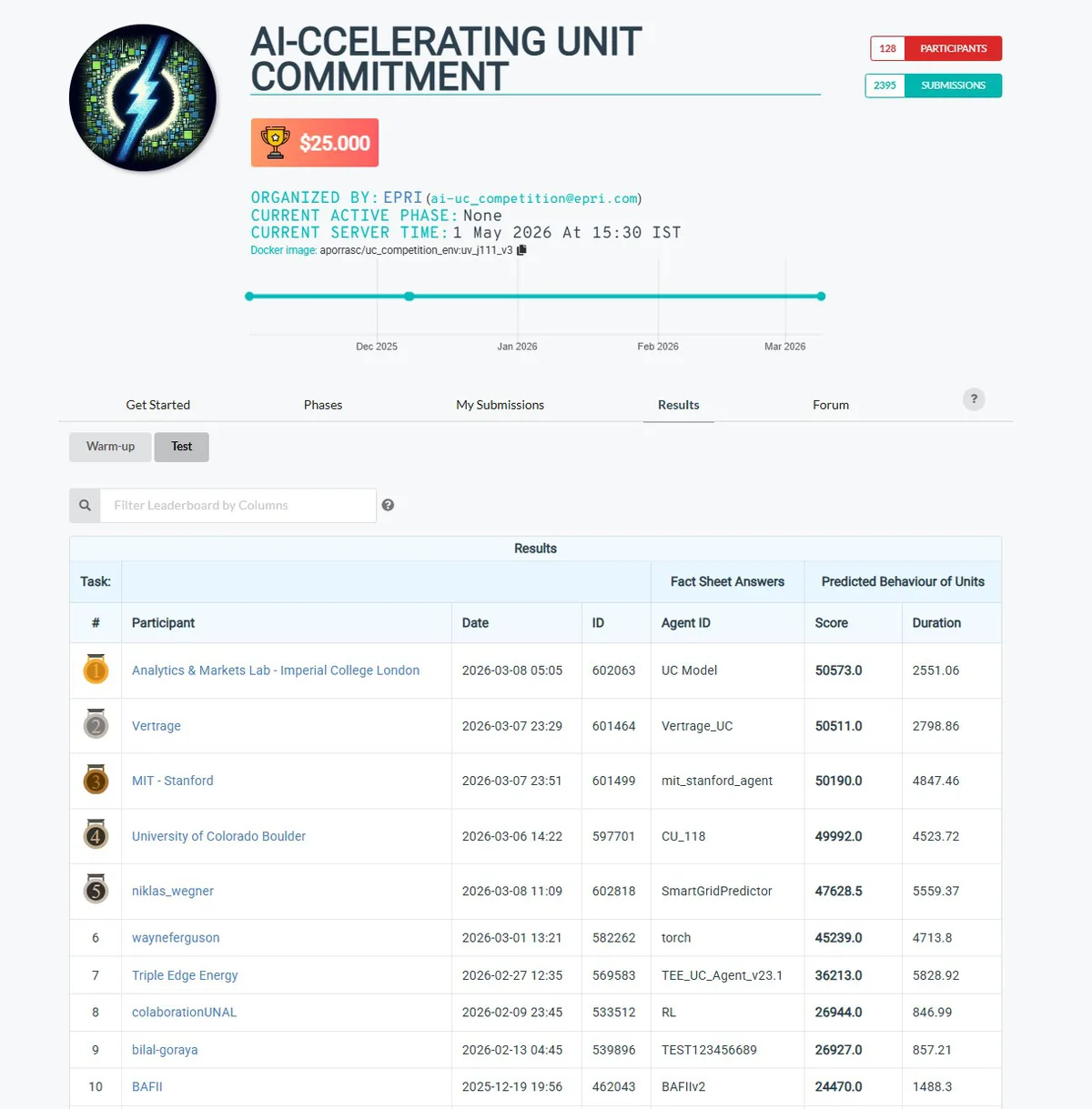
EPRI AI-Accelerating Unit Commitment Challenge — final leaderboard. Triple Edge Energy placed 7th of 128 participating organisations across 2,395 scored submissions, alongside Imperial College London (1st) and MIT-Stanford (3rd). Full results at epri.com.
The commercial connection
The Irish energy sector does not generally operate with data quality equivalent to what EPRI published for this competition.
In practice, the data rarely arrives in one place or one format. A single flexible site’s information is typically scattered across the DSO’s metering systems, the asset manufacturer’s platform, on-site control systems, and operator spreadsheets - each with its own structure, resolution, and gaps. Much of it is still gathered and reconciled manually. Before any optimisation method can run, that fragmented, non-standardised data has to be assembled (wrangled!) into a consistent picture of what each asset is, what it can do, and what it costs to move.
Demand flexibility and BESS dispatch optimisation face the same fundamental structure as unit commitment: find the best schedule given physical constraints and an economic objective. The mathematical programming tools exist. One lesson from the competition carries over directly: our entry was weakest exactly where conditions departed from its training data, so the approach we apply commercially is built to stay robust under novel conditions rather than depend on having seen them before. But the harder and more valuable work sits earlier - getting fragmented, manually-assembled data into a state where any of these methods can run reliably at all.
The competition was a useful stress-test of what is achievable when the data foundation is solid. That foundation is what Triple Edge Energy’s work in flexibility markets is largely about.
Interested in how this applies to your flexible assets or portfolio? Get in touch
References
- EPRI (2025) AI-Accelerating Unit Commitment Challenge. Electric Power Research Institute. Available at: epri.com
- SEMC (2021-2029) Irish SEM Generation System PLEXOS Model. Single Electricity Market Committee validation dataset, used as competition benchmark.